Understanding Maryland Non-Compete Law: A Comprehensive Guide

In today's competitive business landscape, understanding non-compete agreements is crucial for employers and employees alike. Maryland non-compete law, in particular, has unique characteristics that both parties must navigate carefully. This comprehensive guide aims to shed light on the nuances of Maryland's non-compete agreements, ensuring that businesses protect their interests without infringing on the rights of their employees, and that employees understand their obligations and rights under these agreements.
What is a Non-Compete Agreement?
A non-compete agreement is a legal contract between an employer and an employee, wherein the employee agrees not to enter into competition with the employer after the employment period is over. These agreements also prohibit the employee from starting a similar business or working for a competitor within a certain geographic area and for a specified period.
The Legal Framework of Maryland Non-Compete Law
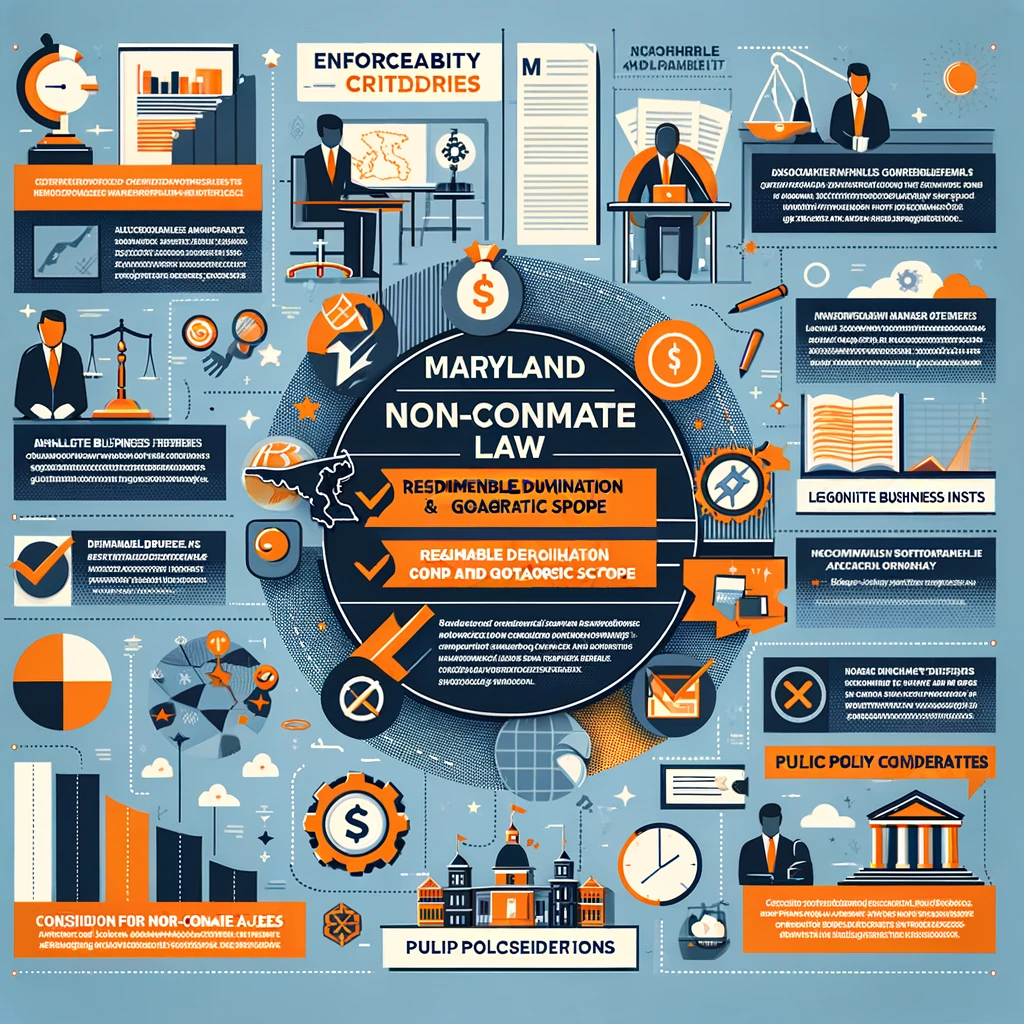
Maryland's approach to non-compete agreements is guided by a principle that balances protecting a business's legitimate interests and preserving an individual's right to work. According to Maryland case law, for a non-compete agreement to be enforceable, it must be:
Ancillary to an employment relationship or a lawful contract.
Supported by adequate consideration.
Necessary to protect the employer's legitimate business interests.
Reasonable in duration, geographic scope, and the activities it restricts.
Not against public policy.
Reasonableness and Enforceability
The reasonableness of a non-compete agreement is a pivotal factor in determining its enforceability in Maryland. Courts will consider the duration and geographical limitations of the agreement to ensure they are not excessively restrictive. Typically, agreements that extend beyond what is necessary to protect the employer's interests are viewed unfavorably.
For example, a two-year restriction might be considered reasonable for high-level executives with access to sensitive business information, while such a duration might not be justifiable for lower-level employees. Geographic restrictions must also be proportional to the area where the employer operates and where the employee had influence.
Protecting Legitimate Business Interests
Employers must demonstrate that non-compete agreements protect legitimate business interests, such as confidential information, trade secrets, and customer relationships. These interests are deemed worthy of protection under Maryland law.
Consideration for Non-Compete Agreements
Consideration refers to what the employee receives in exchange for agreeing to the non-compete terms. In Maryland, the initial employment or a bona fide advancement can constitute adequate consideration. However, the mere continuation of at-will employment may not always suffice, especially for existing employees who are asked to sign a non-compete agreement well into their employment without any additional benefit.
Public Policy and Employee Rights
Maryland courts will not enforce non-compete agreements that contravene public policy or impose undue hardship on employees. Agreements that effectively prevent an individual from working in their chosen field or geographic location are likely to be scrutinized and possibly deemed unenforceable.
Recent Developments and Legislative Trends
It's important to note that there has been a growing trend across the United States, including Maryland, towards limiting the scope and enforceability of non-compete agreements, especially those involving low-wage employees. Lawmakers are increasingly concerned about the potential misuse of these agreements to inhibit worker mobility and wage growth.

Create & Review Your Contracts 10x Quality and Ease
Lawyer-level AI handles all your contract needs, with real lawyers providing safeguarding support

Conclusion and Recommendations
For businesses, it's essential to carefully draft non-compete agreements that are narrowly tailored to protect legitimate business interests without overreaching. Employers should consult legal expertise to ensure their agreements are compliant with current Maryland law and to anticipate any legislative changes.
Employees, on the other hand, should fully understand the implications of signing a non-compete agreement. It's advisable to seek legal advice to assess the agreement's fairness and enforceability.
For more in-depth information on Maryland non-compete law and its application, readers can consult authoritative resources such as the Maryland Attorney General's Office and educational content on Wikipedia.
By staying informed and consulting with legal professionals, both employers and employees can navigate the complexities of Maryland non-compete law effectively, ensuring their interests are safeguarded while respecting legal boundaries and ethical considerations.